Mao Zedong’s granite profile dominates the southern tip of a narrow river island that most visitors to Changsha’s riverside core see from a distance before they ever set foot on it. Orange Isle — Juzizhou in Mandarin — splits the Xiang River for roughly five kilometers just west of downtown, and it carried visitors, poets, and foreign diplomats long before the statue went up in 2009. This guide covers the island’s two storylines: the centuries of river life and literature that came before Mao, and the single 1925 afternoon that turned a sandbar park into a pilgrimage site.
Length
~5 km
Narrowest 40m, widest 140m
Admission
Free
Shuttle train costs extra
Statue height
32 meters
Completed 2009
A River Island With a Head Start on Mao
Local chroniclers were describing Orange Isle centuries before anyone associated it with twentieth-century politics. Tang-dynasty poet Du Fu wrote about the island while visiting nearby Yuelu temples, and it later made the traditional list of Eight Views of Xiaoxiang, a canon of scenic spots along the Xiang and Xiao rivers that shaped Chinese landscape painting for generations. Qing-dynasty authorities opened the island to the public as a pleasure ground in 1904, and the decades that followed brought an unusual wave of development: between 1911 and 1949, foreign consulates and trading offices built summer villas and office buildings along its banks, drawn by the cooler river air. Orange Isle Bridge, completed in 1972, gave the island its first fixed road link to the mainland — at the time, the first bridge of any kind across the Xiang River north of Hengyang — and vehicle traffic across it is now restricted from 7:00 a.m. to 10:00 p.m. on weekends and national holidays, keeping those daytime hours clearer for the foot and bike traffic that peaks then.
The Poem That Made Orange Isle Required Reading
Mao knew the island from his student years in Changsha, when he and friends — among them He Shuheng, Xiao Zisheng, and Cai Hesen — swam in the Xiang River near its banks. He returned in 1925, by then a young organizer rather than a student, and wrote “Qinyuan Chun: Changsha” (沁园春·长沙) after revisiting the spot in autumn. Its closing lines are set explicitly at the island’s southern tip, describing the Xiang River running north beneath a crowded autumn sky — the same view the statue now occupies. Chinese literature classes still teach the poem today, which is part of why so many domestic visitors arrive already able to recite a few lines of it.
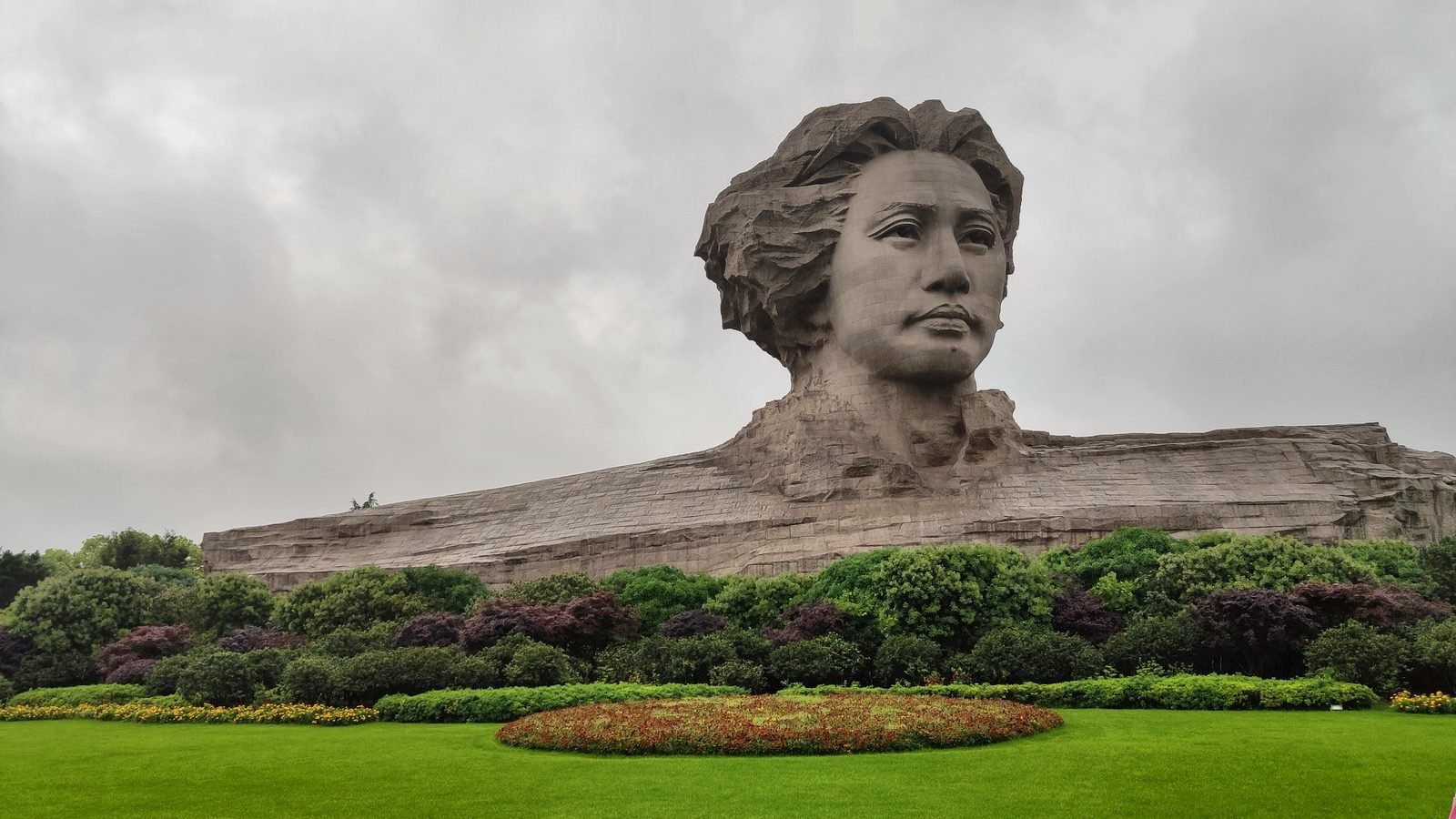
The Young Mao Zedong Statue
Sculptor Li Ming, a Changsha native trained at the Guangzhou Academy of Fine Arts, designed the statue together with the Hunan Provincial Architectural Design Institute, and construction crews from Changsha, Fujian, and Xuzhou broke ground in 2007. Workers quarried more than 8,000 blocks of a red-grey granite called Yongding Red from Longyan, Fujian — more than 800 tons of stone in total, with 1,776 blocks for the head alone — and built the final structure around a reinforced-concrete core. The statue was finished in December 2009, timed to coincide with Mao’s December 26 birth anniversary that year. Every dimension carries a number tied to his life: 32 meters for his age when he wrote the 1925 poem, 83 meters — one for each year he lived — running front to back, and 41 meters across, marking the span between the 1935 Zunyi Conference, where he rose to Communist Party leadership, and his death in 1976. Visit near sunset if photos matter: the statue faces roughly southwest, and raking light along the tree-lined approach path gives the most-photographed angle on the island.
Walking the Island
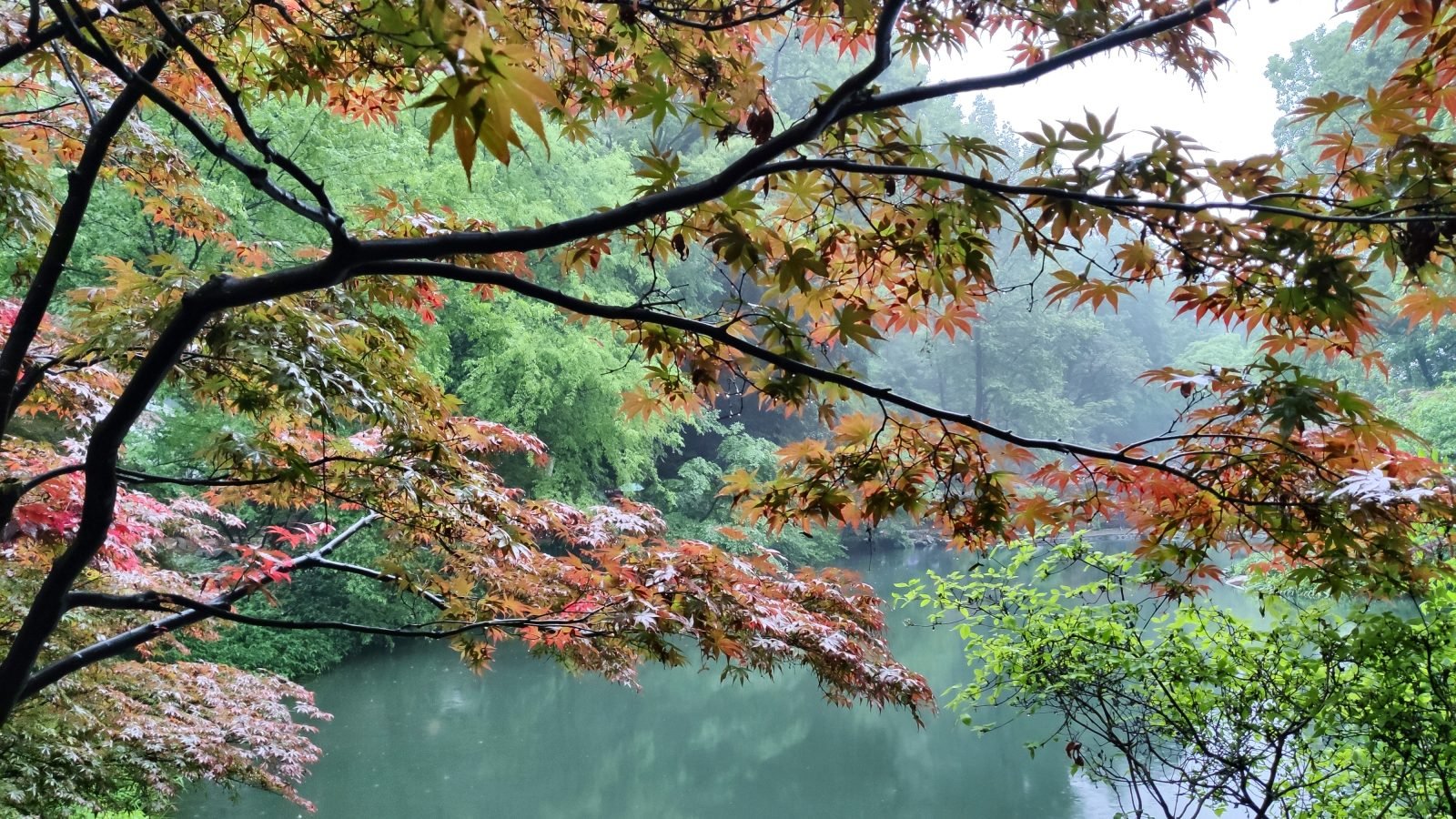
Past the statue, the island opens into the part most locals actually come for: a riverside path running almost the full five kilometers, flanked by more than 3,000 orange trees that give the island its name. October and November bring the harvest, when fruit sellers mark prices directly on individual trees and the paths fill with families picking their own. A 10,000-square-meter cultural square near the statue hosts occasional performances and exhibitions, and bike rental stands near the main entrance make the full length manageable in an afternoon without much walking fatigue. Spring brings a second good window, from late March through April, when the orchards flower and crowds thin out compared to autumn weekends.
- Budget 2–4 hours — the island is long and narrow; a one-way ride on the internal shuttle train plus a walk back covers most of it without exhausting a full day.
- Buy shuttle tickets at the booth, not WeChat — the shuttle runs roughly ¥20–40 depending on the route and season; online purchase has been unreliable for some visitors, so budget a few extra minutes at the ticket window near the entrance.
- Bring your own water and snacks — food stalls inside the park are limited and priced higher than off-island options.
- Paths are stroller- and wheelchair-friendly — the main walkway is paved and level, with ramps at the major pavilions and the statue plaza.
Evening fireworks aren’t guaranteed
Orange Isle hosts fireworks displays over the river on select weekend evenings during the warmer months, but the schedule changes by season and isn’t published far in advance. Check signage at the entrance or a local listings app the day of your visit rather than planning an evening specifically around a show.
Getting to Orange Isle
Metro Line 2 to Juzizhou Station — the exit leads straight to the island’s main entrance at the north end. From there it’s a shuttle ride or a long walk south to the statue at the island’s tip — budget accordingly, since the park is longer than it looks on a map.
Walk across Orange Isle Bridge — from the Yuelu District side of the Xiang River, a pedestrian path along the bridge reaches the island’s road entrance in about fifteen minutes on foot; vehicle traffic across the same bridge is restricted from 7:00 a.m. to 10:00 p.m. on weekends and national holidays.
Taxi or Didi — drops passengers at the main gate; useful outside metro operating hours or when carrying luggage between other Changsha stops.
Orange Isle works best as a half-day stop inside a longer Changsha itinerary that also takes in Yuelu Mountain and the rest of downtown. Travelers continuing south toward Chenzhou find a very different kind of Hunan scenery: the red sandstone walls at Gaoyi Ridge, the fog-covered water at Xiaodongjiang, and the old-growth forest trails at Mangshan. Hungry travelers headed that way should also look at this site’s guide to Chenzhou’s East River fish and fish noodles before moving on.
Frequently Asked Questions
Is there anything inside the statue itself, or is it just a viewpoint from outside?
The base holds a memorial hall and exhibition space of roughly 2,000 square meters, built into the structure beneath the head. Photographs and documents inside cover Mao’s student years and early organizing work in Hunan, and entry is included in the island’s free admission — most visitors miss it entirely because the queue for photos with the statue’s exterior draws all the attention.
I’m arriving by high-speed rail at Changsha South Railway Station — how do I get to Orange Isle?
Metro Line 2 connects the two main railway stations directly, so take it from Changsha South Railway Station straight to Juzizhou Station without transferring. Set up a transit QR code in Alipay or WeChat Pay before you arrive; it works at every gate along the line and saves a stop at the ticket machines.
I’ve already visited Mao’s hometown at Shaoshan — is Orange Isle worth adding too?
Yes, for a different reason. Shaoshan preserves Mao’s childhood home and family history, while Orange Isle commemorates a single moment: his 1925 return to Changsha as a young organizer, captured in the poem the statue illustrates. The two sites cover different decades of the same life, and visiting one doesn’t make the other redundant if Mao’s biography interests you.
What if it rains during my visit?
Light rain won’t close the island, and the main paths drain quickly, but the shuttle train sometimes suspends service in heavier storms, which turns a short ride into a long walk back to the entrance. Check the forecast the morning of your visit and keep an indoor backup — Hunan Museum is the obvious choice — in case the weather turns during the day.
How do I get from Orange Isle across to the Yuelu Mountain side of the river?
There’s no scheduled public ferry between the two. Retrace your steps to Juzizhou Station, ride Metro Line 2 one stop to Xiangjiang Middle Road, and catch a short taxi toward the mountain’s east gate; walking back across Orange Isle Bridge to catch a taxi from the mainland side works just as well and takes about the same time.