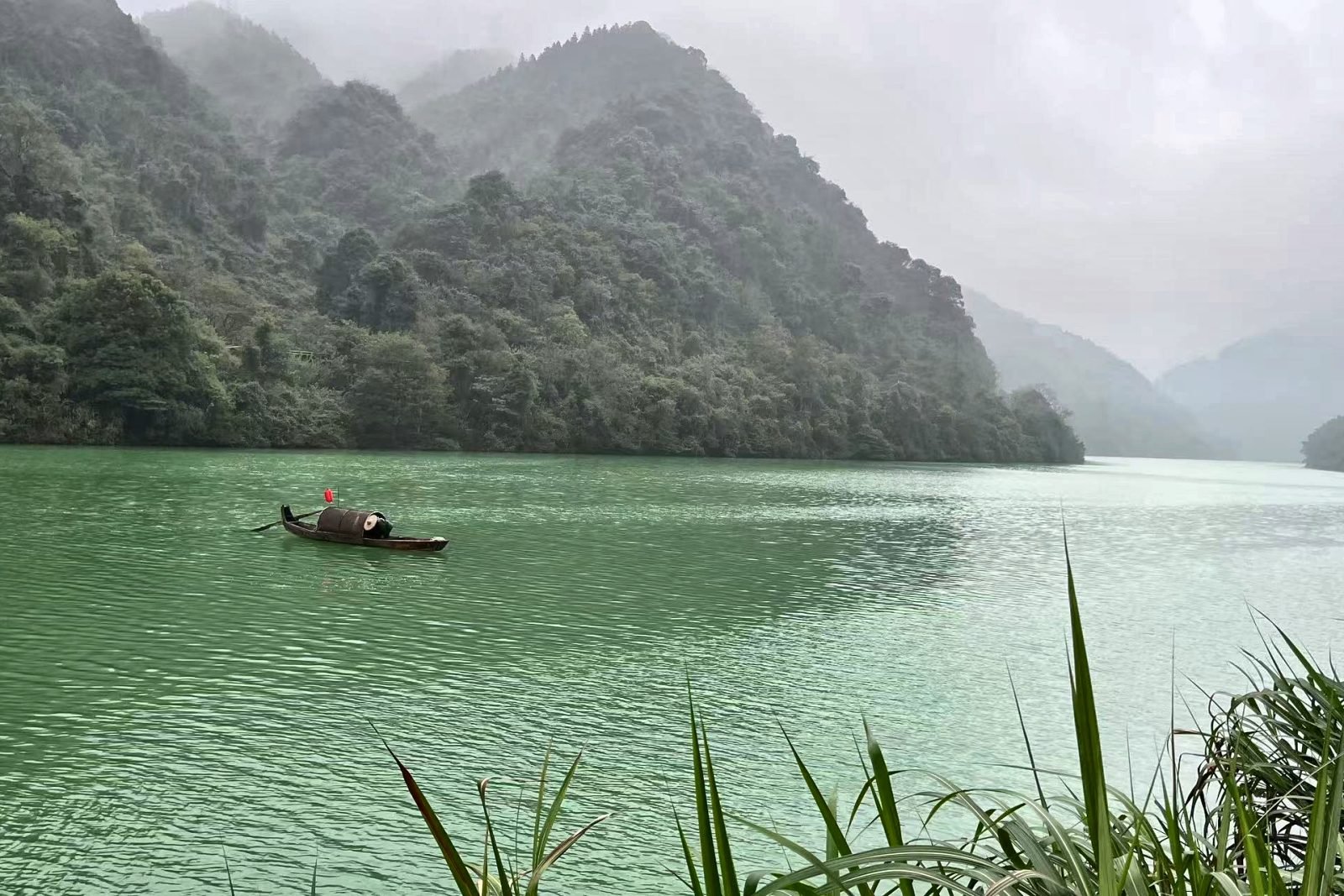
Dongjiang Lake’s reservoir water sits at a near-constant eight to twelve degrees Celsius, cold enough that fish raised and caught there taste nothing like the warm-pond fish found elsewhere in Hunan. Thirty kilometers north, a river crossing called Qifengdu built its name and its local economy around a single bowl of noodles. Between them, these two dishes explain most of how Chenzhou eats: everything starts with water, and almost nothing goes to waste. Our Chenzhou travel guide covers the city’s scenery; this one covers what to eat once you get there.
East River Fish
Cured, smoked, or fresh-caught
From Dongjiang Lake near Zixing; buy cured, eat fresh lakeside
Qifengdu Fish Noodles
Breakfast noodle soup
From Qifengdu town in Suxian District; best eaten before midday
Heritage status
Provincial ICH listing (2016)
Qifengdu fish noodles only; East River fish has no heritage listing
East River Fish: From Reservoir to Smokehouse
Engineers built the reservoir that became Dongjiang Lake in the 1980s, damming valleys around Zixing for hydropower. What resulted was one of Hunan’s clearest, coldest bodies of water, and the fish raised in it ever since carry none of the muddy aftertaste common to warmer, pond-raised freshwater fish elsewhere in the province.
Local legend credits the dish’s fame to a royal visitor, though which one depends on who is telling the story: some accounts name Qin Shi Huang, others a travelling princess. In most versions, the visitor survived a boating accident nearby, ate fish stewed with chili to fight off the cold, and declared it fit for tribute. Treat this as folklore rather than history — sources disagree on the details, and what actually survived from that period is the curing method itself, passed down through generations of local fishing families.
How the Cure Becomes the Flavor
Catching and processing happen on a tight clock: fishermen aim to have the catch into the cure within eight hours, since any longer in open air dulls the final flavor. Processors salt the fish in clay jars, slow-fry it in tea oil, then finish it over smoke from pine wood and tea-seed husks — a two-stage process that gives the fish its deep amber color and faintly resinous smell.
Timing follows the solar calendar rather than the clock. Fishermen target Cold Dew, in early October, for the catch, and Frost’s Descent, roughly three weeks later, for smoking, when cooler air slows spoilage during the long cure. Several distinct products come out of this: delicate East River silver fish, barely larger than a finger; whole smoked and tea-oil-roasted fish; a rose-tinted pickled version fermented with wild mountain chilies; and dried fish that has picked up awards at Hunan’s provincial agricultural expo.
A Modern Spin on an Old Cure
Some of today’s chefs treat the cured fish as an ingredient rather than a finished dish on its own. Roasted East River fish turns up tossed through pasta; the silver fish gets a tempura batter and a quick fry; fish-bone stock, built from the trimmings, becomes the base for a laksa-style noodle soup. None of this is traditional — it is a recent, deliberate reinvention by local chefs — but it shows how far a once strictly local specialty has traveled on area menus.
Where to Eat and Buy It
Two separate experiences wait around the lake. Cured, smoked, and pickled East River fish works as a take-home specialty: look for it packaged at lakeside shops and local markets around Zixing, sold by weight, and ask how recently a batch was cured if freshness matters to you. Fresh fish from the lake, by contrast, is what shows up on a restaurant plate. Yumeiren’s East River Lake branch (渔美人·金鳟三文鱼文化主题餐厅, Wangjiazhuang 88, East River Lake Scenic Area; +86 199 7353 3899) serves both farmed trout and classic lake fish like steamed mandarin fish, with reviewers reporting an average spend around ¥65 per person — treat that figure as a rough guide and confirm current prices on site or by phone before ordering.
The lake’s cold water has also supported newer aquaculture ventures: sturgeon farms upstream now export fish as far as Vietnam, and some lakeside restaurants plate farmed trout — marketed locally as “salmon” — as sashimi or fried rice. It is a recent addition to the lake’s food economy, not a substitute for the cured East River fish that gives this specialty its name.
- Buying cured fish — ask the curing date before you buy; East River fish tastes best within a few weeks of smoking, not after sitting on a shelf for months.
- Spice level — both East River fish and Qifengdu noodles lean on local five-finger chilies; say 不要辣 (bù yào là) if you want a milder version.
- Cash and mobile pay — small stalls and markets often prefer WeChat Pay or Alipay over cash; carry both set up before you arrive.
- Packing fish to travel — ask for a double-bagged, vacuum-sealed package if you plan to carry cured fish onward, especially by air.
Qifengdu Fish Noodle Soup: A Three Kingdoms Legend in a Bowl
Qifengdu is a river-crossing town in Chenzhou’s Suxian District, and its noodle soup has long since outgrown the town itself — versions of it turn up as breakfast across the whole city. Local legend ties the dish to Pang Tong, the Three Kingdoms-era strategist nicknamed the “Fledgling Phoenix,” who is said to have spent a sleepless night at this ferry crossing, then returned at midday too hungry to wait, only to find the local noodle stall already closed. Luck intervened: a fisherman returning from the river handed over his catch, and the stall owner simmered it into a broth with local fermented soybean and tea oil, then ladled it over rice noodles set aside for a festival. Pang Tong is said to have gone on to serve well in the post the district later gave him, and locals credit the crossing’s name — roughly, “the ferry where the phoenix roosted” — to that visit. As with the East River fish story, treat this as oral history rather than a documented event.
Sixteen Steps, Three Stages
Making the dish properly takes three stages and around sixteen separate steps, starting with rice milled into batter, steamed into sheets, and cut into noodles — a process locals call “making the powder.” The broth comes next: grass carp or silver carp simmered down with ginger, local fermented soybean (known here as 豆果, dougu), and five-finger chilies until it turns milky white. To assemble a bowl, the cook spoons tea oil in first, then the broth and noodles, then the fish, then a scatter of scallions and a final few drops of tea oil on top.
The dish earned provincial-level intangible cultural heritage status in 2016, and in 2023 one of the workshops preserving the craft was recognized nationally as a model heritage enterprise — official validation for something locals never doubted.
A Bowl Worth the Detour
Qifengdu and the villages around it support more than forty fish-noodle shops, serving a combined total that local reporting puts at over ten thousand bowls a day across breakfast, lunch, and dinner, and long-haul truck drivers on nearby National Highway 107 are known to pull over just for a bowl. One packaged-noodle company based in the town now ships cup versions of the soup to more than ten countries, including Germany, Egypt, and the Philippines, and holds close to twenty patents on its process. Thousands of local farming households, including dozens formerly registered as living below the poverty line, supply the ingredients that keep the industry running.
A well-known local saying sums up the attachment: no matter how far you travel, it is the bowl from Qifengdu you cannot forget.
Getting There and a Bowl to Sit Down To
Qifengdu sits roughly 40 minutes by bus from central Chenzhou. Bus 817 runs from the Intercity Bus Station (城际大巴客运站) directly to Qifengdu Hub Station (栖凤渡枢纽站), with buses every 20–28 minutes between about 6:10am and 5:50pm; get off near the stops marked 栖凤渡老市场 (Qifengdu Old Market) or 栖凤渡镇政府 (Qifengdu Town Government), where the fish-noodle shops cluster most densely. Taxis and Didi ride-hail cars cover the same distance faster, which helps if you are short on time or traveling outside bus hours.
Go early. Most shops open around 5:30am and serve their freshest batches before the late-morning rush. If a particular stall has a long line, that is usually a sign it is one of the better ones — Qifengdu locals are particular about where they eat, and so are the regulars who drive in from elsewhere in Chenzhou just for breakfast.
Planning Your Visit
These two dishes sit roughly 40 kilometers apart and in different directions from central Chenzhou, so treat them as two separate outings rather than one loop. East River fish and the lake itself pair naturally with a Zixing day trip — the same route that reaches Gaoyi Ridge’s danxia cliffs continues on to the lake, so a hiking morning and a lakeside lunch fit into one day without much extra transit. Qifengdu, by contrast, sits closer to the city center and makes an easy breakfast stop before or after a morning at Xiaodongjiang’s misty river, which lies in the same direction. Build your day around whichever district you are already headed toward.
Frequently Asked Questions
Why do lakeside menus list “salmon” if Dongjiang Lake is nowhere near the ocean?
It is farmed rainbow trout, not ocean salmon. Cold, clear reservoirs like Dongjiang Lake are well suited to trout farming, and Chinese menus commonly label this fish 三文鱼 (“salmon”) regardless of species — a naming convention used across many of China’s cold-water fish-farming regions, not something unique to Chenzhou. It is a different product from both true ocean salmon and the traditional cured East River fish, so order it as its own thing rather than expecting the historic specialty.
Can I bring cured East River fish home, including on a flight?
Vacuum-sealed or well-wrapped packages of dried and smoked fish travel fine in checked luggage, and airlines rarely restrict dried seafood on domestic or international routes. The smoked smell can be strong in a closed car or hotel room on the way, so ask the seller to double-bag it. If you are connecting to another country, check that destination’s import rules first — several countries, including the US, Australia, and EU member states, restrict bringing in dried animal products regardless of packaging.
Which bus do I take to reach Qifengdu, and how do I pay?
Bus 817 connects Chenzhou’s Intercity Bus Station directly to Qifengdu Hub Station, running roughly every 20–28 minutes from just after 6am to just before 6pm. Fares are paid on boarding, so have small change ready, or use a local transit card or the Yicard/WeChat mini-program if you already have one set up — English-language payment apps are not accepted on local buses. Baidu Maps or Amap both track the route in real time if you want to confirm your stop as you ride.
Do I need to speak Mandarin to order at a fish-noodle stall?
Not really. Most stalls run on a simple point-and-pay system, and a phone showing a translated phrase or a photo of the dish works fine. Portion size and spice level are the two things worth gesturing about directly — hold up fingers for how much chili you want, and nod or shake your head when the cook holds up the ladle.
Can I find cured East River fish year-round, or only right after the autumn harvest?
Freshly cured batches appear right after the autumn harvest, from October through the following few months, but packaged dried and smoked versions are sold year-round at lakeside shops and increasingly online. If freshness matters to you, ask how recently a given batch was made — older stock can sit on a shelf for months before it is sold.