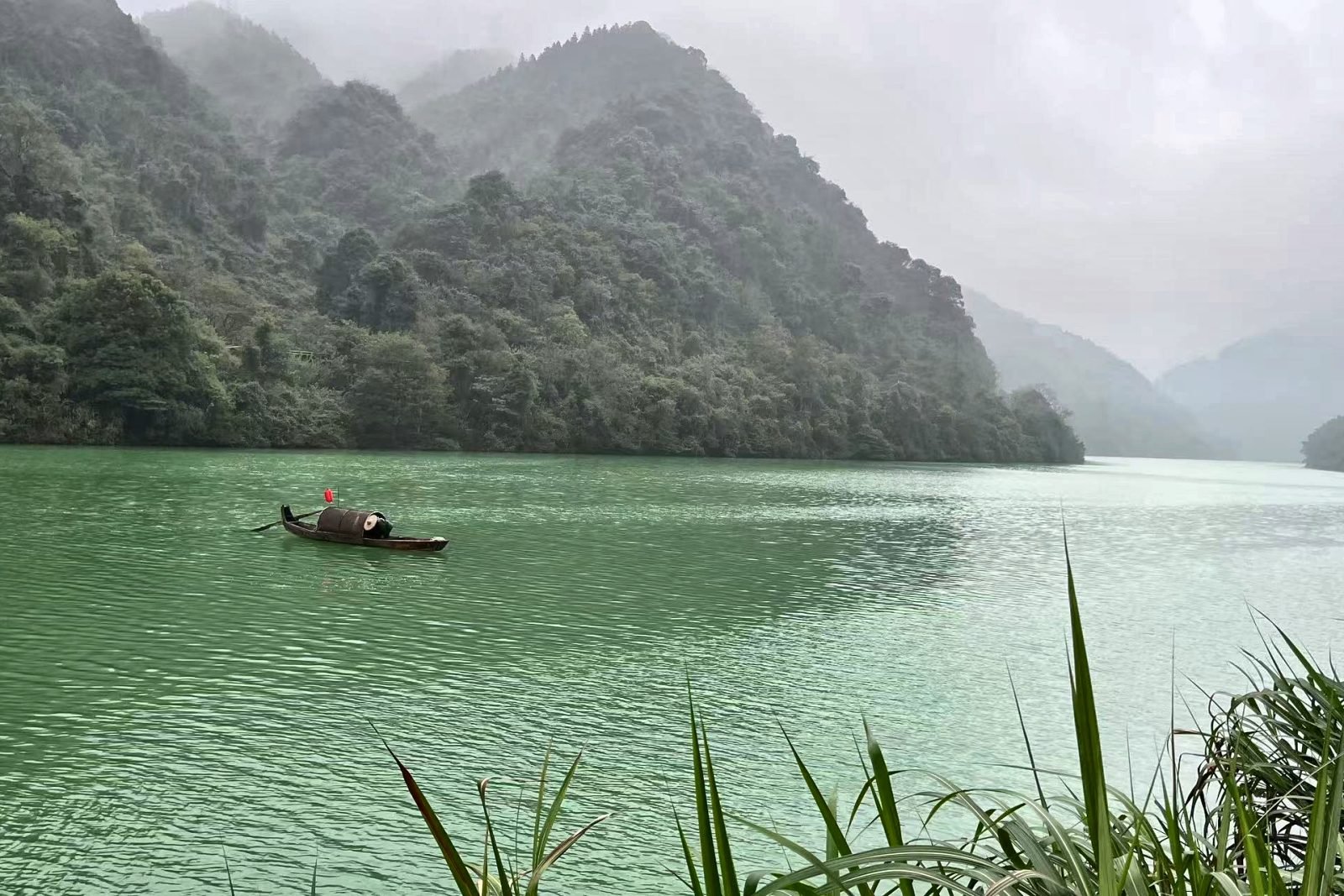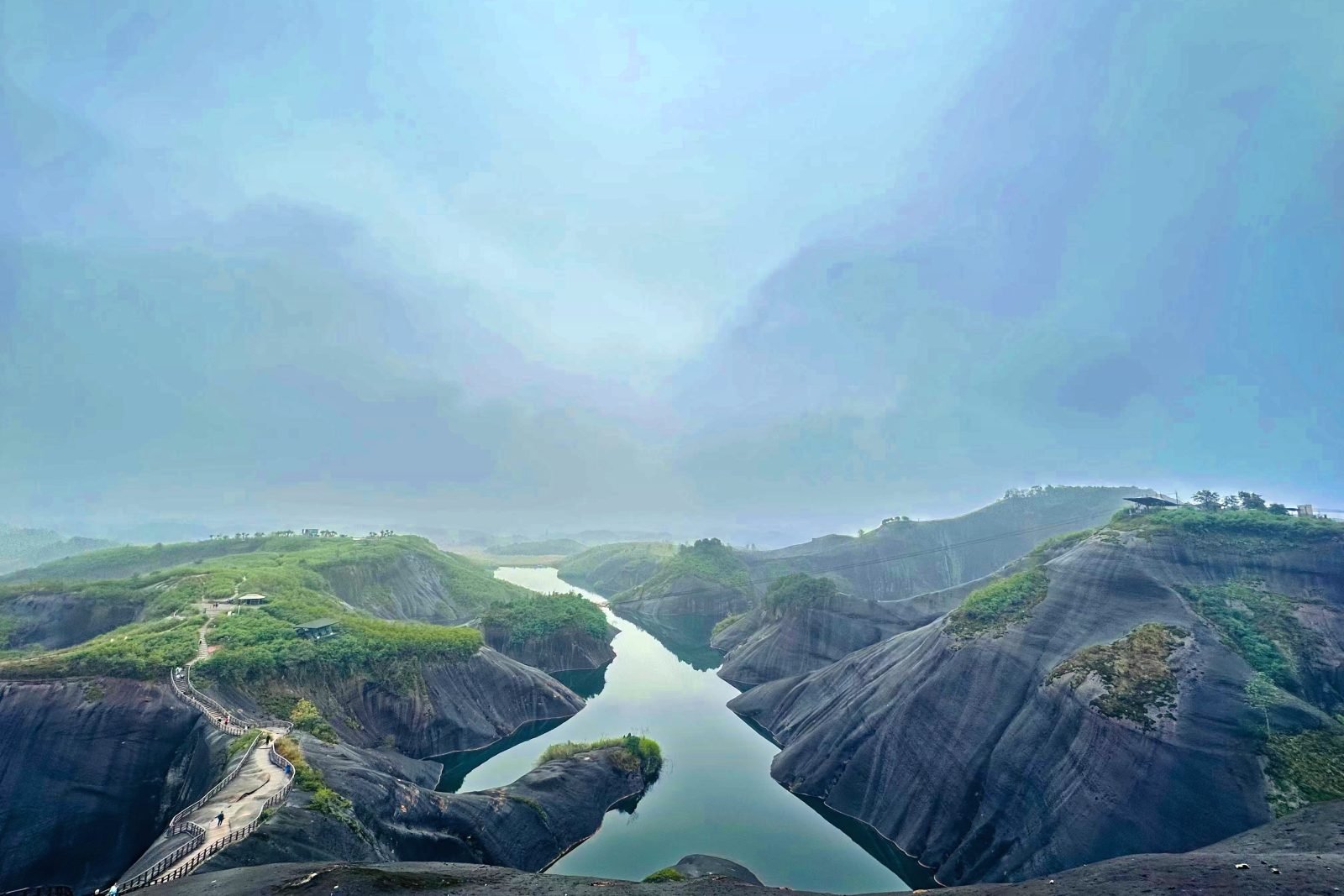
Mangshan sits at Hunan’s southern edge, where the Nanling range folds into Guangdong, holding one of the largest stretches of untouched evergreen broadleaf forest left at this latitude anywhere in China. Our Chenzhou city guide introduces Mangshan alongside Gaoyi Ridge and Xiaodongjiang as one of three essential day trips from the city; this guide goes further, covering the barrier-free trail system that lets almost anyone reach the ridge tops, and the story of the venomous snake that put this patch of forest on the map.
Location
Yizhang County, Chenzhou
Southern Hunan, on the Guangdong border
Hours
8am–6pm
Adjusted seasonally; confirm before an early or late visit
Ticket
roughly ¥65–80
Adult admission; sources quote slightly different rates, so check the current price at the gate or on Trip.com/Ctrip
A forest that never got logged
Mangshan National Forest Park covers 198.33 square kilometers, and forest canopy covers 99.01 percent of that area — one of the highest coverage rates of any reserve in the country. Chinese tourism authorities describe it as holding one of the largest and best-preserved stretches of primitive evergreen broad-leaved forest found anywhere at this latitude, and the reserve carries an informal reputation as a flora and fauna “gene bank” for the sheer density of species packed into a relatively small protected area. It holds China’s national 4A scenic-area rating, status as a national popular-science education base, and a spot on Hunan’s official list of top-ten summer retreats — elevation here keeps the air noticeably cooler than Chenzhou’s lowland summer, which is the main reason travelers come in July and August as much as they do in spring or autumn.
Wuzhifeng: a mountain built for every kind of visitor
Wuzhifeng, the core scenic area inside the park, has been promoted by local tourism officials as the first mountain scenic area in China engineered specifically around full barrier-free access — a claim worth treating as marketing framing rather than a verified record, but the infrastructure on the ground backs up the intent. Steep natural terrain here has been routed around rather than climbed.
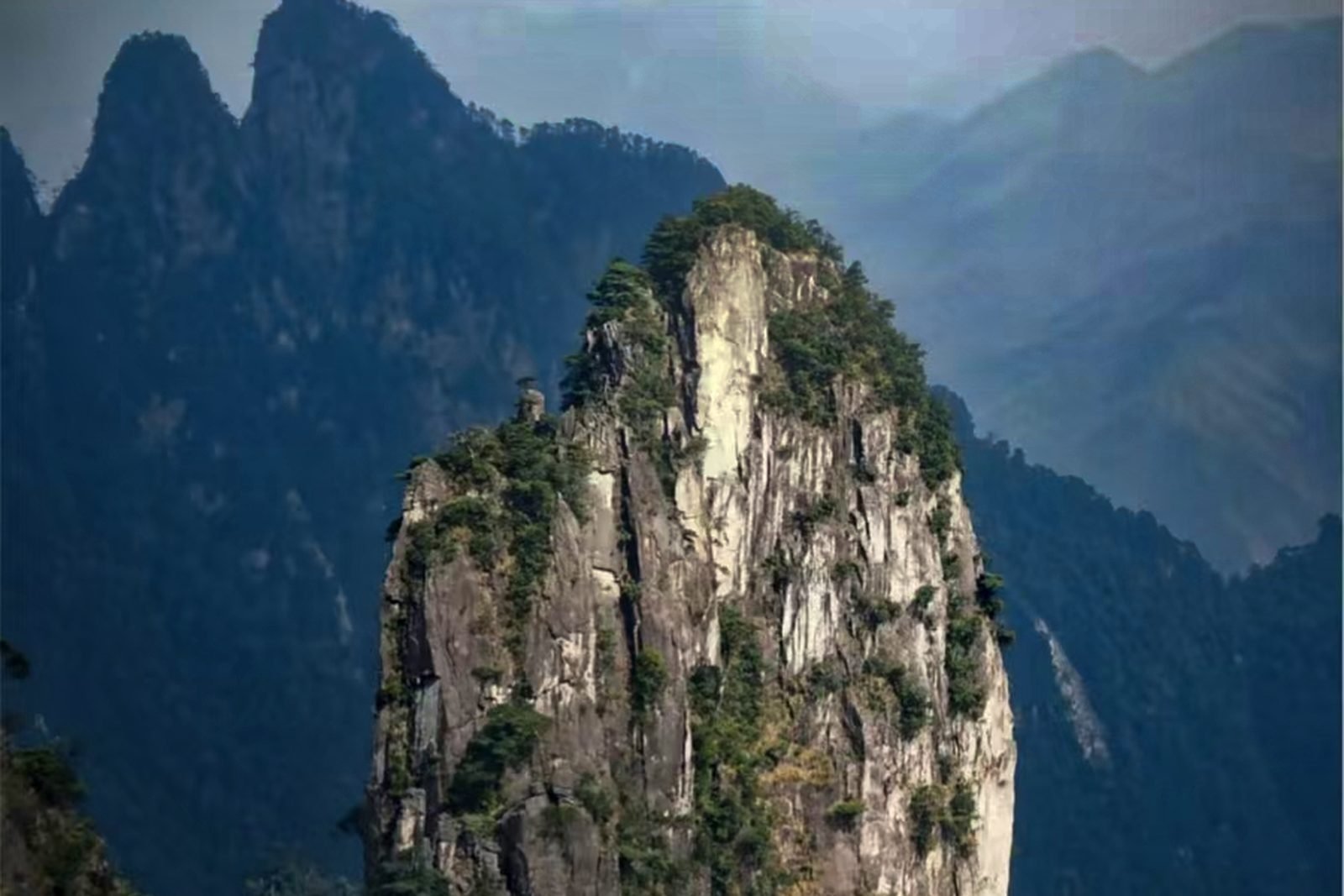
Cableway — this 11-minute scenic cable car carries visitors from the east gate up to the ridge, climbing well above the tree canopy on the way.
Elevators and escalators — vertical lifts and escalators cover the sections where the trail would otherwise require climbing stairs, so wheelchair users and visitors with limited mobility can reach viewpoints that would normally demand a steep hike.
Wheelchair lifts — short stair sections that can’t be avoided entirely are fitted with powered lift platforms rather than ramps.
Flat boardwalks — most of the walking path across the ridge is level decking, not stepped trail, so a stroller or a cane works fine for long stretches.
Multilingual signage — route markers and audio guides run in Chinese, English, Japanese, and Korean, and the park posts free rain capes and ginger tea at several rest points.
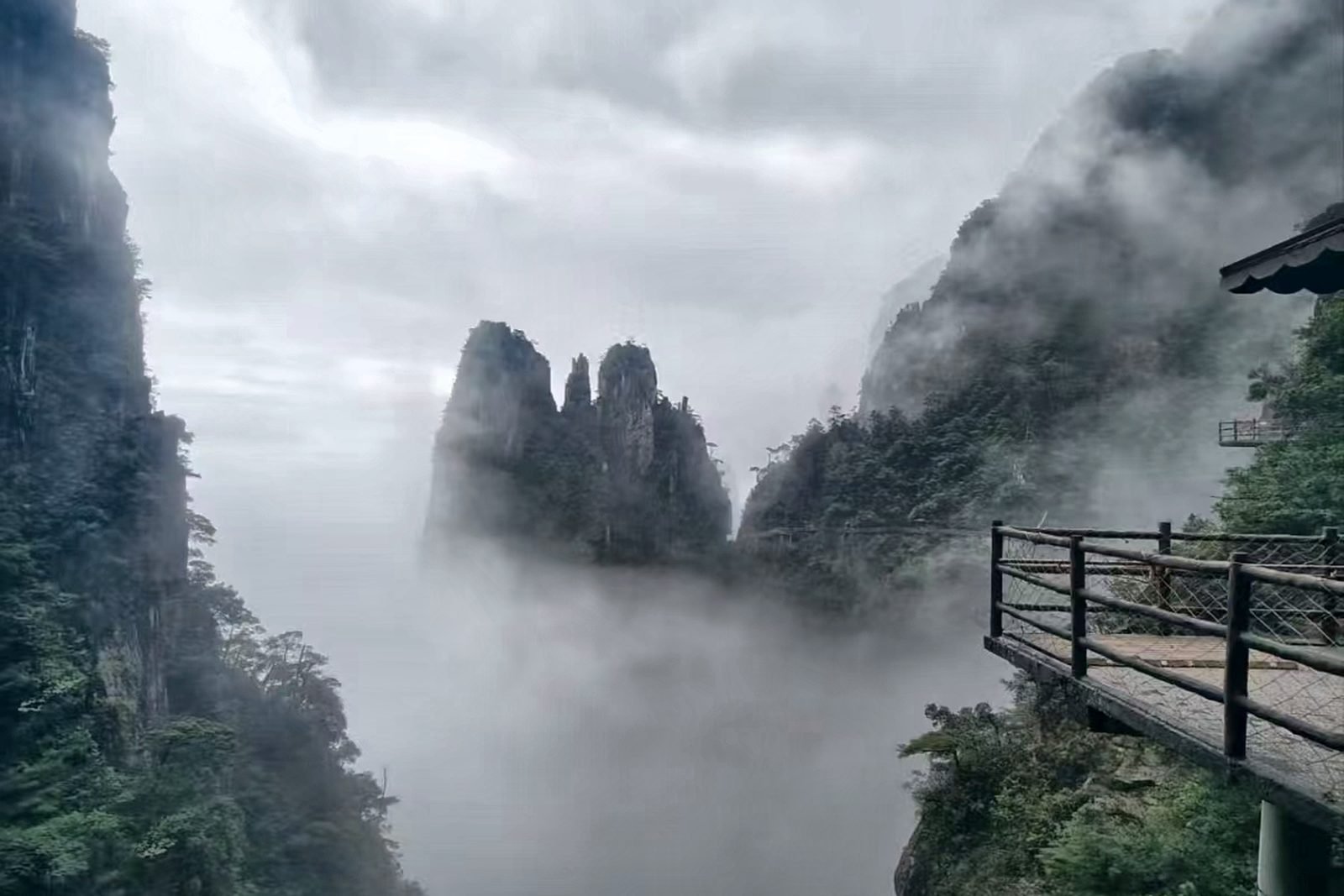
Access differs by gate. From the east gate, a five-minute shuttle or the cableway reaches Wuzhifeng directly. From the west gate, expect roughly a 40-minute shuttle ride or a 40-minute hike in on foot — a reasonable option for visitors who want some unassisted walking before reaching the barrier-free sections higher up.
The snake that nearly killed the man who found it
Mangshan’s other claim to fame lives mostly out of sight. In 1984, a forestry technician named Chen Yuanhui treated a local snakebite victim whose fang marks spanned 3.5 centimeters — unusually wide for anything in the area’s known snake population. That patient described a large snake with a white-tipped tail, matching a local Yao legend about a creature called the “little azure dragon.” Chen went looking for it himself, found a thin, green-patterned snake with the telltale white tail, and was bitten twice while trying to collect it. He deliberately delayed treating his own wound so he could photograph the snake’s fangs first — a decision that put him in a coma for three days and eventually cost him part of a finger.
Five years later, in 1989, a second specimen surfaced, and Chen sent it to the Chengdu Institute of Biology at the Chinese Academy of Sciences. In 1990, he and herpetologist Zhao Ermi jointly published the formal description in the journal Sichuan Journal of Zoology, naming it the Mangshan pit viper — the 50th venomous snake species known in China at the time, and only the second giant, highly venomous snake species discovered anywhere in the world after the king cobra.
This snake is endemic to one pocket of China: wild populations exist only inside Mangshan National Nature Reserve and the adjoining Nanling reserve just across the border in Guangdong. It’s a Class I nationally protected animal, and the Wildlife Conservation Society estimates roughly 500 individuals remain in the wild. Mangshan’s own Natural History Museum tells the discovery story in detail, alongside preserved specimens, for visitors who’d rather see one up close than go looking in the forest.
Don’t go looking for the pit viper yourself. It’s a protected, highly venomous species, and Wuzhifeng’s boardwalks are built to keep foot traffic away from the dense undergrowth where it actually lives — a chance encounter on the main trail is rare precisely because of that design. Stay on the marked path, keep closed-toe shoes on even on the flat sections, and if you want to hike beyond Wuzhifeng into the park’s less-developed forest, go with a local guide rather than exploring on your own.
Beyond Wuzhifeng
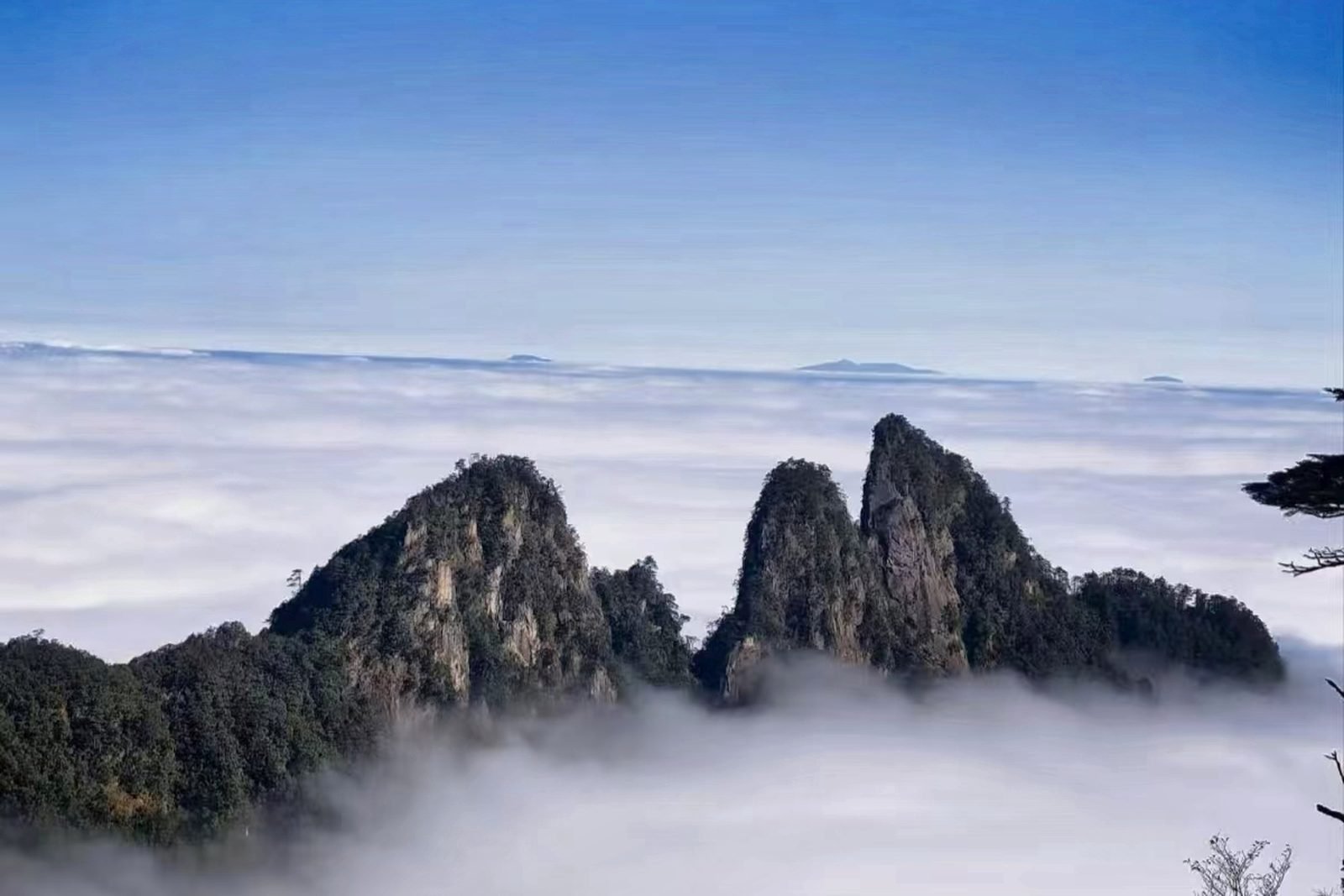
Several other draws sit within or just outside the core scenic area. On misty mornings, the cableway ride doubles as a cloud-sea viewpoint, with the ridge below disappearing under a layer of white while only the taller peaks break through. Short-tailed macaques turn up near the forest edges often enough that close encounters are a regular part of a visit, not a rare stroke of luck. Near the east gate, a Yao ethnic folk performance runs seasonally, built around a mock “mountain liquor challenge” in which a visitor has to down a cup poured from a long bamboo tube before “winning” a dance partner, alongside mountain-song call-and-response and a bamboo pole dance.
Mangshan Grand Canyon, a separate rafting attraction nearby, runs a 9.8-kilometer river course through an undeveloped gorge with a 298-meter total drop — a serious whitewater outing rather than a gentle float. Operators have reported the rafting as temporarily closed in the past, so treat it as a seasonal add-on and confirm it’s running before building a day around it rather than assuming it’s open. Sold separately from the standard Mangshan ticket, an annual pass bundles entry to several nearby attractions in the same mountain range — Tiantai Mountain, General’s Stronghold, and Monkey King Stockade among them — for travelers planning more than one day in the area.
Getting there
Mangshan sits roughly a two-hour drive south of central Chenzhou, deep enough into Yizhang County that most visitors either drive or combine a high-speed train with a bus transfer.
Self-driving to the east gate (Wuzhifeng side): take the Beijing–Hong Kong–Macau Expressway, exit at Pingshi West, then follow National Road 107 and the signposted Dongyang tourist road to the gate.
Self-driving to the west gate: take the Beijing–Hong Kong–Macau Expressway to the Yichang–Lianzhou Expressway, exit at Huangsha, then follow the Huangmo tourist road.
By train and bus: take a high-speed train to Chenzhou West Railway Station, then transfer to a coach toward Yizhang/Mangshan at the Tianlong bus station. Schedules change by season, so check current departure times through the 12301 national tourism hotline, the park’s ticket line (0735-3991182), or a booking app like Trip.com before you travel — don’t plan around a fixed timetable found online.
Planning a visit
Budget at least four to five hours for Wuzhifeng alone if you’re using the cableway and the full boardwalk loop, longer if the Natural History Museum and a Yao culture show are part of the plan. Discounts apply at the gate: visitors aged 14–18 or 60–65, along with full-time students, generally qualify for half-price tickets, while children under 1.2 meters, seniors over 65, people with disabilities, and active-duty or retired military personnel typically enter free — bring ID to claim any of these at the counter rather than assuming online pricing already reflects them. Pair a Mangshan day with Gaoyi Ridge’s Danxia cliffs or the misty river at Xiaodongjiang if you’re spending several days around Chenzhou — both sit within the same southern Hunan cluster and work well as a change of pace from a full day of barrier-free ridge walking.
FAQ
Is Mangshan realistic for someone in a wheelchair or with limited mobility?
Use the east gate route — its cableway, elevators, and wheelchair lift platforms cover nearly every elevation change between the gate and Wuzhifeng’s main viewpoints, and most of the connecting path is flat boardwalk rather than stepped trail. West-gate access works differently: it relies on a 40-minute shuttle or a 40-minute walk-in with less built-out assistance along the way, so visitors who need barrier-free facilities should enter from the east side specifically, not just pick whichever gate looks closer on a map.
How do I get from Chenzhou to Mangshan without renting a car?
Take a high-speed train to Chenzhou West Railway Station, then transfer to a coach bound for Yizhang/Mangshan at the Tianlong bus station. Rural bus schedules shift with the season, so confirm the current departure time before you go — either by phone to the park’s ticket line (0735-3991182), through the 12301 national tourism hotline, or by checking a travel app like Trip.com or Amap’s public-transit routing the morning of your visit.
Is the Mangshan Grand Canyon rafting trip running when I visit?
Don’t assume it is. This rafting operator has closed the route for stretches in the past, likely tied to water levels and season; the body text above reflects the most recent status we could confirm. Call ahead or check the operator’s listing on a booking platform the same week as your trip — treat it as a possible add-on rather than something to build a fixed itinerary around.
Will I actually see the Mangshan pit viper during a visit?
Almost certainly not in the wild, and that’s by design. Wuzhifeng’s boardwalks route foot traffic away from the dense undergrowth the snake actually lives in, and with roughly 500 individuals estimated to exist across the entire wild population, the odds of a chance encounter on the main trail are very low. Its Natural History Museum is the reliable way to see one instead — it displays specimens alongside the story of how the species was discovered, so nobody needs to go looking in the forest.