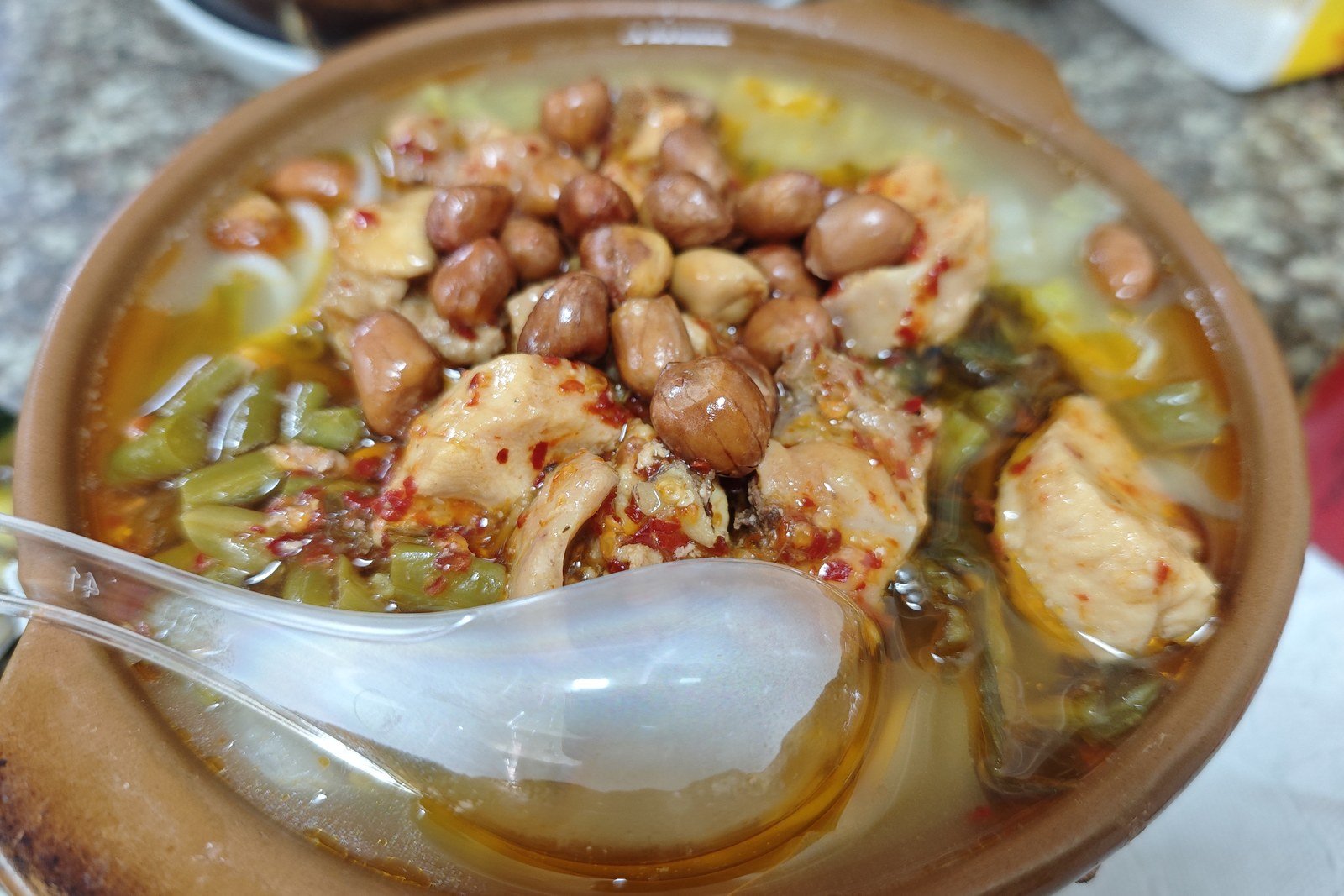
The best thing we ate in Zhanjiang was not seafood. It was a clay pot of rice noodles under a heap of peanuts, with chilli-red chicken, cabbage, a quail egg and pickled long beans crowded around the edge, eaten at a roadside table with a plastic spoon.
It is called la ji fen — literally “spicy chicken noodles” — and the version that matters comes from Wuchuan, the coastal county-level city inside Zhanjiang that also lends its name to the airport. It is cheap, it is everywhere once you know to look, and it is almost completely unknown outside the region.
What La Ji Fen Actually Is
Strip it back and it is a bowl of rice noodles in a chicken broth, with stir-fried spicy chicken on top. What makes it its own dish rather than a generic noodle soup is the combination of textures piled into one bowl: soft noodles, tender chicken, crunchy peanuts, sour-salty pickled long beans, and a broth that is light rather than heavy despite the chilli oil sitting on top.
It is worth saying plainly that this is not an ancient dish. A local Zhanjiang write-up is honest about it: la ji fen is not a traditional Wuchuan recipe, it is a street food that took hold and became one — shops opened one after another in the old Meilu quarter, and it stuck because it was good and cheap, not because anyone was preserving a tradition. The same piece tracks the price climbing steadily over the years, from a few yuan a bowl in its early days. We paid ¥12 in 2026, which is still less than a coffee.
What Is in the Bowl
Ours arrived with all of the following, and the standard version is close to this:
- Rice noodles — round, soft, soaked rather than fresh-pressed.
- Spicy chicken — bone-in pieces, red with chilli, stir-fried rather than braised.
- Peanuts — a generous heap, and the single most important topping.
- Pickled long beans — chopped short, sour and salty, cutting through the oil.
- Cabbage — usually baby cabbage, wilted into the broth.
- Quail eggs — on the fuller versions.
- Dressed cucumber — served on the side in a small cup, cold and sharp.
The peanuts are the part people get wrong when they describe this dish. They are not a garnish. There are enough of them to change every mouthful, and because they go in late they stay properly crunchy in the broth instead of going soft. Take them out and you have an ordinary bowl of noodles.
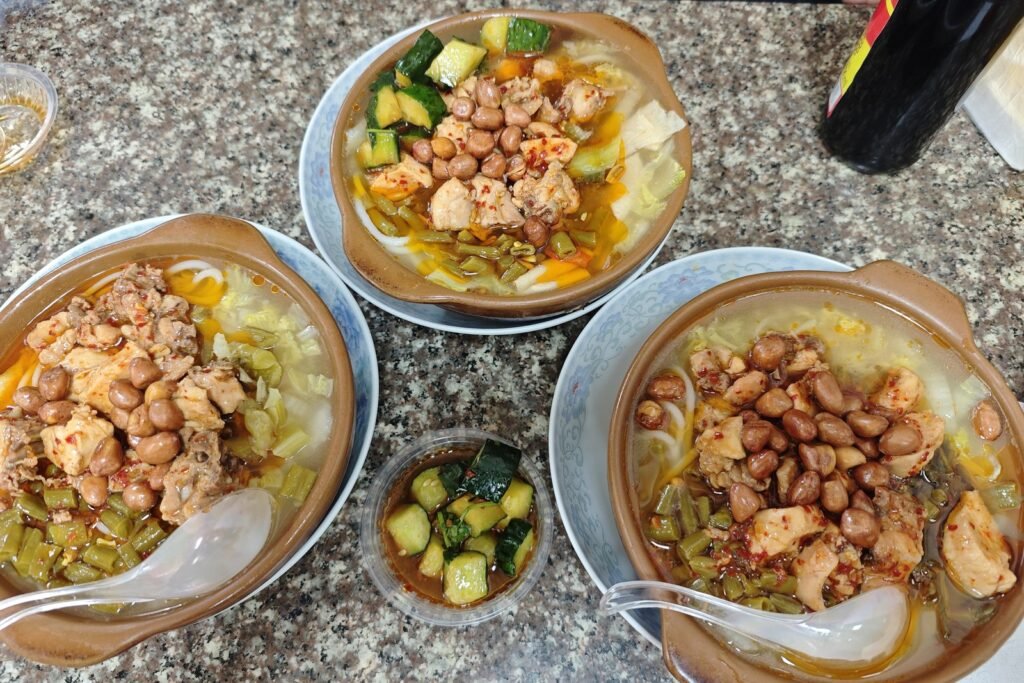
The same local write-up describes the upgraded clay-pot version as adding quail eggs, tofu skin and ham sausage on top of the chicken-pickle-peanut base, with the dressed cucumber alongside — which is exactly what turned up in front of us.
Wuchuan or Maoming: The Difference That Matters
Two neighbouring cities on this stretch of coast make a dish with the same name, and they are not the same bowl. If you only ever eat one, this is the distinction to know.
Wuchuan
Stir-fried, juicy
Chopped, marinated, fried hard and into the bowl while still moist
Maoming
Drier, diced
Cooked further and cut small, aromatic rather than tender
Nearest cousin
Hunan chilli chicken
What the Maoming bowl most resembles
In Wuchuan the chicken is chopped, marinated and stir-fried hard, then goes into the bowl while it still has water in it. The pieces are soft, slightly slippery, and they carry the chilli as a coating rather than as a dry rub. In Maoming the chicken is taken further — drier, diced small, more aromatic, and closer in character to the diced spicy chicken you would recognise from Hunan.
Neither is wrong. But they are eaten differently: the Wuchuan bowl is about the chicken and the broth together, the Maoming one is about the chicken as a topping. Our preference, for what it is worth, is the Wuchuan version — and Zhanjiang is where you eat it.
Why It Comes in a Clay Pot
The better shops finish the bowl in a sha wo — a rough, unglazed clay pot, usually scorched black around the base from being set straight over the flame. It is not presentation. The pot holds heat, so the broth is still moving when it reaches you and the noodles keep cooking for the first minute at the table.
Practically, this means two things. Eat it quickly, because the bottom of the pot keeps working on the noodles and they will soften past their best if you leave them. And do not touch the pot itself — the handles get as hot as the base.
Where to Eat It
The dish belongs to Wuchuan, and the densest concentration of shops is in the old Meilu quarter there. But you do not need to make a special trip: la ji fen has spread across Zhanjiang’s urban districts, and the shops are ordinary neighbourhood places rather than destinations.
What to look for: a small shopfront with stacked clay pots, granite or stainless tables, a pot of peanuts and a tub of pickled beans within reach of the cook, and no menu longer than a laminated sheet. If the peanuts are being scooped fresh rather than sitting in broth, you are in the right place.
We are not naming shops
We ate this at a roadside place and did not record the name, so we are not going to invent one. This is a description of the dish and how to recognise a good version of it, not a list of addresses. If you find a shop you like in Zhanjiang or Wuchuan, that is the one.
How to Order
Most shops work on a base bowl plus additions. The base is chicken, pickles and peanuts; the additions are quail eggs, tofu skin, ham sausage and extra chicken. Order the fuller version the first time — the eggs and tofu skin soak up broth and are worth the couple of yuan.
On heat: it is chilli-red but not punishing. The oil carries most of the heat and it sits on the surface, so you can control it by how deep you fish with the spoon. If you want it milder, say so when ordering rather than trying to fix it afterwards.
Take the cucumber seriously. It comes cold and sour in its own cup, and alternating between it and the hot bowl is how the dish is meant to be eaten, not an afterthought.
On price: our fully loaded bowl came to ¥12 in 2026. That is what we paid at one roadside shop, not a fixed rate — expect it to vary a little by shop and by how much you pile on, and to creep upwards over time. It is still one of the cheapest proper meals you will eat in Guangdong.
Making It at Home
It is a reasonable dish to attempt outside China, because nothing in it is hard to source. The method that home cooks use follows the shops closely: chop a whole chicken, keep the feet and trimmings back for stock, marinate the meat, stir-fry it hard with doubanjiang, dried chilli, garlic, ginger and spices, then simmer the stock separately and bring the two together over soaked rice noodles with baby cabbage in a clay pot. A Chinese home recipe lays out that sequence step by step.
The two things worth copying exactly: stir-fry the chicken rather than stewing it, and add the peanuts at the end so they stay crunchy. Get those right and the rest is forgiving.
Frequently Asked Questions
How is it different from Liuzhou luosifen?
Beyond both being rice-noodle bowls, almost nothing connects them. Luosifen is a Guangxi dish built on river-snail broth and fermented bamboo shoot, and its signature is a sour, pungent soup. La ji fen is coastal Guangdong: chicken stir-fried to order, pickled long beans and peanuts, heat that comes from chilli rather than fermentation. Liking one tells you very little about whether you will like the other.
Is there a version without meat?
Not really. Chicken is the dish rather than a topping on it, and the stall’s whole method is built around cooking it to order. Pickled beans, peanuts, cabbage and quail egg come with the bowl but are not sold as a bowl of their own. Ask the shop if you need to avoid meat, and expect to be pointed toward something else on the street instead.
What do people eat or drink after it?
Sugar water. Zhanjiang runs on tong sui, and a cold bowl of it after a hot, chilli-heavy one is the standard local sequence rather than a tourist invention. Shops cluster near the markets and stay open through the late afternoon, which is also the point in the day when the city is otherwise closed.