
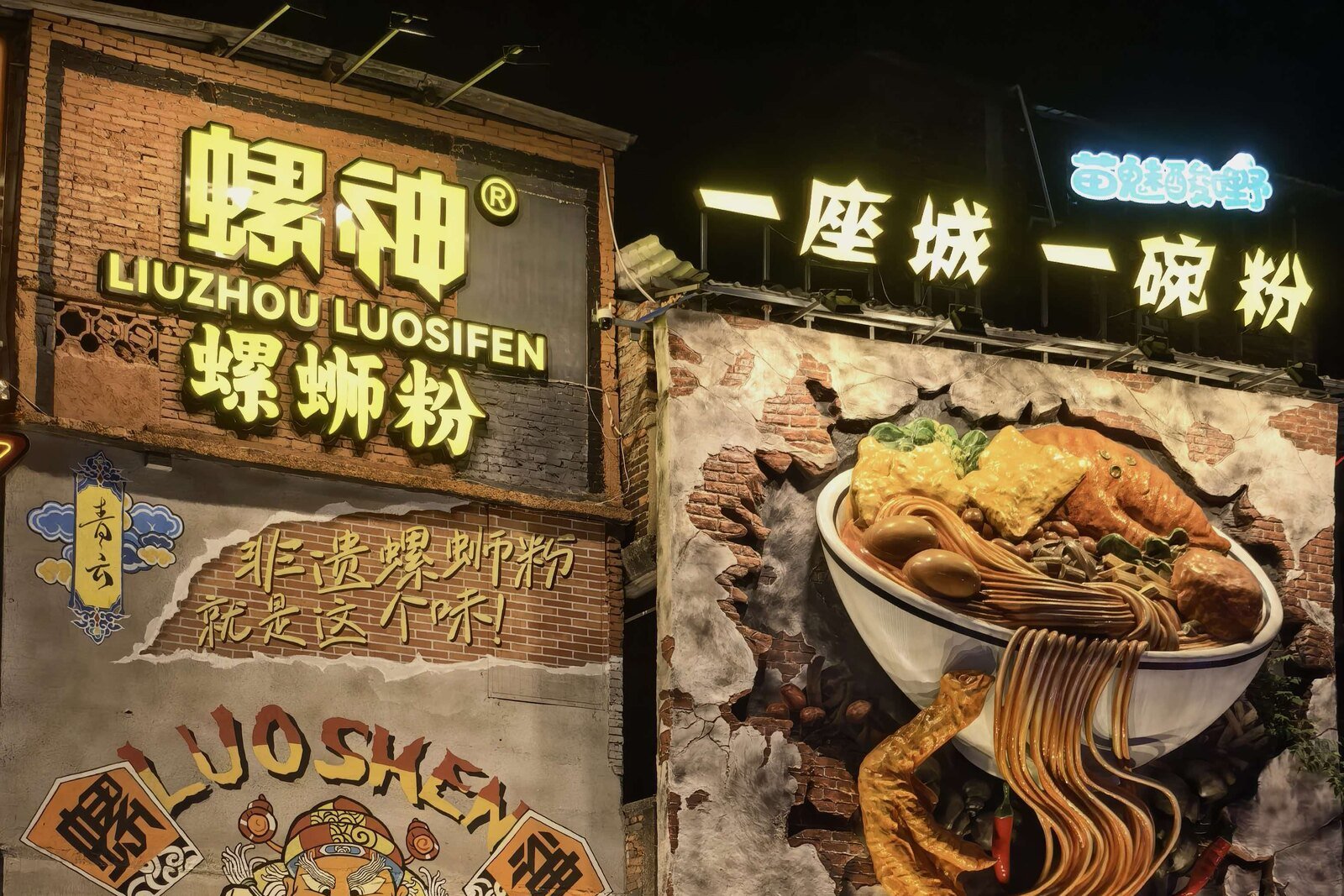
A City with a Triple Identity
Mention Liuzhou, and most people’s first thought is luosifen (螺蛳粉) — the Guangxi snail rice noodle soup famous for “smelling terrible, tasting amazing.” It has practically become the city’s calling card. But spend a little time getting to know Liuzhou and you’ll find it’s far more layered than a single bowl of noodles. It’s one of China’s few mid-sized cities that doubles as a heavyweight industrial base — SAIC-GM-Wuling, Dongfeng Liuzhou Motor, and Liugong Machinery are all headquartered here, and Wuling’s best-selling minivans and EVs seem to be on every rural road in the country. At the same time, it’s a criminally underrated landscape city: the Liujiang River wraps around town like a jade ribbon, karst peaks rise between the streets, and the nighttime light show along “hundred-mile Liujiang” holds its own against far more famous tourist destinations.
Gritty industry, everyday street food, and soft karst scenery — three seemingly contradictory personalities that somehow coexist in Liuzhou. This guide walks through the city’s basic facts, its history and culture, the luosifen phenomenon, its industrial muscle, its landscapes, and the practical details you’ll want before you go. By the end, you should have a full picture of this quietly underrated city.
What Kind of City Is Liuzhou?
Liuzhou sits in north-central Guangxi Zhuang Autonomous Region, with the Liujiang River winding through the city from west to east — hence the local saying “hundred miles of river, hundred miles of scenery.” It’s Guangxi’s second-largest city after the regional capital Nanning, and an important industrial base and transport hub for southwest China.
The city’s nicknames say a lot about its character. Thanks to its concentration of automakers and manufacturers, Liuzhou is known as the “Motor City” and counts among China’s notable industrial brand cities. Because it’s a major source and trading hub for ornamental stones, it’s also called the “City of Viewing Stones.” And in the past few years, thanks to luosifen going viral nationwide and abroad, it’s widely recognized as the “Home of Luosifen.” An older nickname, “Dragon City” (龙城), lives on in several place names and local legends around town.
Climatically, Liuzhou has a typical subtropical monsoon climate — hot, rainy summers and mild, drier winters. Spring and autumn are the most pleasant seasons and the best windows for a visit.
History and Culture: Over 2,100 Years of Urban Life
Liuzhou’s history as a city stretches back to the Western Han dynasty — more than 2,100 years — and it’s recognized as one of China’s National Historical and Cultural Cities. The city’s name is closely tied to the Tang dynasty writer Liu Zongyuan, who was exiled here to serve as prefect of Liuzhou in 815 CE and remained until his death four years later. During his time in office he founded schools, had wells dug, freed enslaved people, and promoted agriculture — real, lasting contributions that locals still honor today at the Liuhou Shrine (柳侯祠), one of the city’s key cultural sites and a living reminder of the connection between the city’s name and Liu Zongyuan himself.
Human presence in the area goes back much further. In 1958, archaeologists discovered the now-famous “Liujiang Man” skull fossil near Tongtian Rock (通天岩) in Liuzhou — one of the most significant late Homo sapiens fossil finds in China and East Asia. Its exact age has been debated over the years; a comprehensive stratigraphic and dating study published in 2024 by the Institute of Vertebrate Paleontology and Paleoanthropology, Chinese Academy of Sciences, dated the fossil to roughly 23,000–33,000 years ago, offering important new evidence for understanding the evolution and migration of modern humans in East Asia.
Liuzhou and its surrounding counties are also home to a mix of ethnic groups, including Zhuang, Yao, Miao, and Dong communities, whose traditions — from folk songs to festivals — give the region its distinct cultural flavor. The locally beloved legend of Liu Sanjie (“Third Sister Liu”), tied to the city’s Standing Fish Peak, is a great entry point into the area’s folk song traditions.
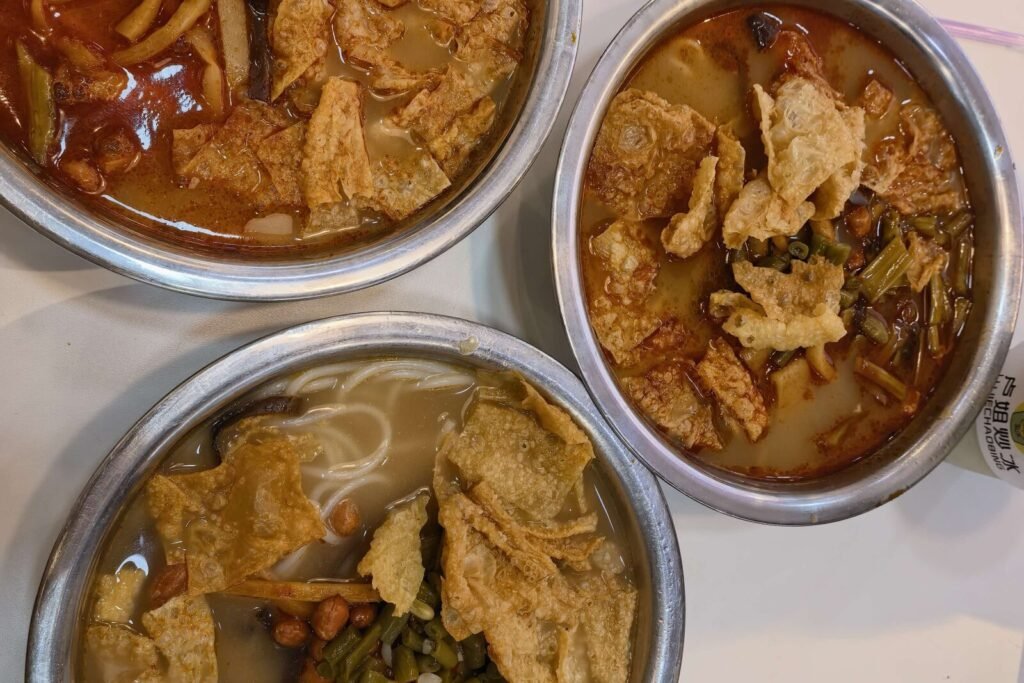
Luosifen: Liuzhou’s Biggest Calling Card
If Liuzhou could be summed up in one dish, most people would pick luosifen without hesitation. This deceptively simple rice noodle soup is built on a broth slow-simmered from river snails and pork bones, topped with fermented bamboo shoots, pickled beans, wood ear mushroom, peanuts, tofu skin, and greens — sour, spicy, savory, crunchy, and served piping hot. Its signature pungent smell comes mainly from the fermented bamboo shoots, which is exactly why it’s often described as “smells terrible, tastes amazing” — a dish people either fall for instantly or approach with real trepidation. For the full breakdown of what’s actually in the bowl and exactly where to eat it, see our deep dive: Liuzhou Luosifen: Why This Smelly, Sour Noodle Soup Is Worth a Special Trip.
Luosifen started out as a humble street food sold from carts and small shops around Liuzhou. Over the past few decades it’s made a remarkable leap — from street stall, to nationwide internet sensation, to a genuine global industry. Riding the boom in ready-to-eat packaged food and e-commerce, luosifen has grown from a bowl cooked fresh on a corner into a full supply chain: growing the bamboo shoots and sourcing the snails, processing and packaging the noodles, and selling through e-commerce and logistics networks. Liuzhou has built dedicated industrial parks around the product to push standardization and scale across the whole chain.
The numbers back up the hype: in 2024, the full luosifen supply chain generated an estimated RMB 75+ billion in sales across Liuzhou; by 2025, that figure had climbed past RMB 81.3 billion, with products selling not just across China but increasingly overseas thanks to innovations like chilled packaging, and export volumes continuing to grow. The city has set even higher targets, hoping to keep expanding the economic ripple effects of what’s essentially become a small-noodle-turned-big-industry story.
Beyond luosifen, Liuzhou’s everyday food culture is worth exploring too: beef brisket rice noodles and pig’s trotter rice noodles are breakfast staples for locals, Liuzhou-style grilled fish has its own local following thanks to a distinctive marinating and charcoal-grilling method, and various other noodle variations each have their own fan base. Slurping a bowl of noodles is, in a real sense, just part of daily life here — a hot bowl in the morning is how the city wakes up. For a closer look at what locals actually order beyond the noodle bowl, see Beyond Luosifen: What Liuzhou Locals Actually Order for a Big Meal.
Industrial Powerhouse: Wuling and “Made in Liuzhou”
If luosifen is Liuzhou’s soft power, automotive and machinery manufacturing is its hard edge. The city’s industrial roots trace back to the Second Sino-Japanese War, when a wave of coastal factories relocated inland to Liuzhou, laying an early foundation. After 1949, Liuzhou grew into one of China’s key industrial bases, and today it’s one of the rare mid-sized Chinese cities that supports a complete automotive supply chain on its own.
Liuzhou’s best-known industrial name is SAIC-GM-Wuling, the company behind China’s “national car,” the Wuling Hongguang minivan, as well as the Wuling Hongguang MINI EV, which for a stretch was one of the world’s best-selling electric vehicles month after month. Alongside Wuling, Dongfeng Liuzhou Motor Co. is a major player in commercial vehicles, and Liugong Group is a leading name in construction machinery, with loaders and excavators exported worldwide. Together, automotive, machinery, and steel form the backbone of Liuzhou’s industrial identity and have earned the city recognition as one of China’s distinctive “Motor Cities.”
Notably, Liuzhou’s industry hasn’t stood still. In recent years the city has pushed hard into new-energy vehicles, battery technology, and AI-driven manufacturing, shifting its industrial structure from traditional combustion-engine production toward electrification and smart manufacturing. For visitors, that means a trip to Liuzhou offers more than scenery and food — it’s also a chance to feel the energy of a modern industrial city in transition.
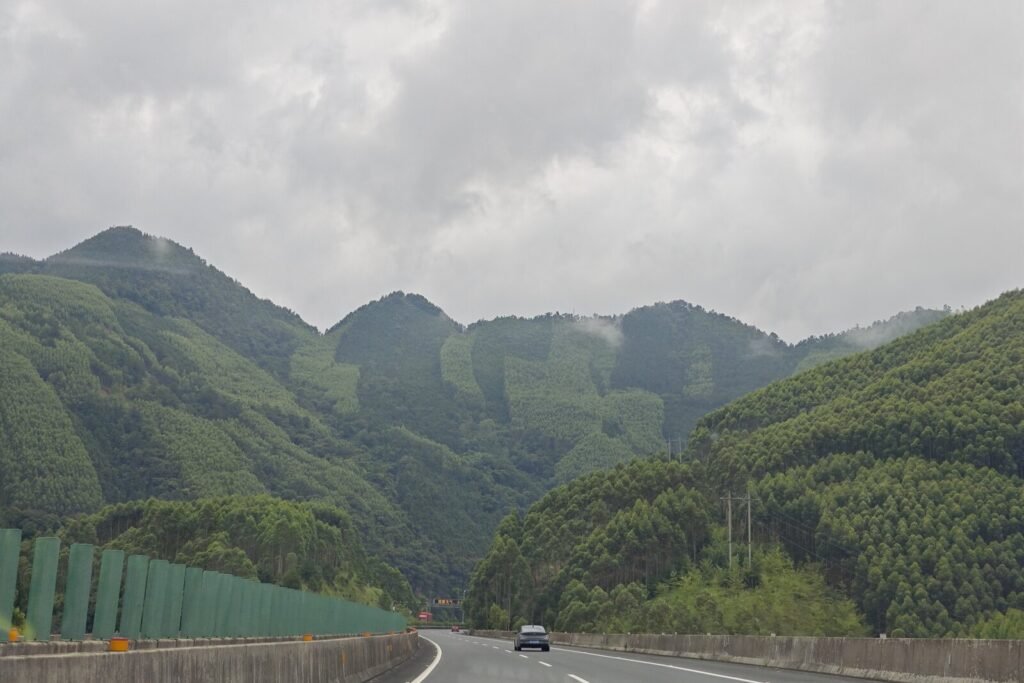
Landscapes: The Underrated “Little Guilin”
Many people don’t realize that Liuzhou sits in the same Guangxi karst belt as Guilin, with scenery that’s genuinely comparable — it’s just been overshadowed by the city’s “industrial” label. The Liujiang River curves through the entire urban core from west to east, wrapping the city in water on three sides and giving rise to the “hundred miles of river, hundred miles of scenery” reputation. At night especially, the riverside light shows reflecting off the waterfront buildings make a boat cruise along the Liujiang one of the most memorable things to do in the city.
The karst peaks in and around the city are also well worth a visit:
- Standing Fish Peak (立鱼峰) — Named for its resemblance to a carp leaping from the water, this is one of Liuzhou’s most iconic peaks and is closely tied to the local legend of Liu Sanjie. The summit offers sweeping views of the river and city.
- Ma’an Hill (马鞍山) — Named for its saddle-like shape, this is one of the higher vantage points in the urban area, offering panoramic views of the river looping around the city.
- Longtan Park (龙潭公园) — Located south of the city center, this park is known for its karst peaks, caves, and clear pools, and is a favorite spot for locals to unwind amid the scenery.
- Duole Cave (都乐岩) — A classic karst cave system with striking stalactite and stalagmite formations, offering a window into the region’s limestone geology.
- Yaobu Old Town (窑埠古镇) — A riverside district built in a traditional Lingnan architectural style, pleasant for a daytime stroll and lively at night with local snacks and nightlife.
- Liuzhou Confucian Temple (柳州文庙) — A notably large temple complex by domestic standards, and a meaningful stop for understanding the city’s Confucian heritage and historical roots.
Liuzhou is also known as China’s “Capital of Ornamental Stones,” thanks to the decorative rocks — like patterned “juanwen” stone and painted pottery stone — sourced from the Hongshui and Liujiang river basins, prized among collectors. The city has dedicated markets and exhibition halls for enthusiasts who want to dig deeper into this niche but distinctly local culture.
With more time, it’s worth extending the trip to Liuzhou’s surrounding ethnic minority counties: Sanjiang Dong Autonomous County is famous for its striking wind-and-rain bridges and drum towers, while Rongshui Miao Autonomous County preserves well-kept Miao villages and festival traditions. Neither is technically part of Liuzhou proper, but both pair naturally with a Liuzhou-based itinerary.
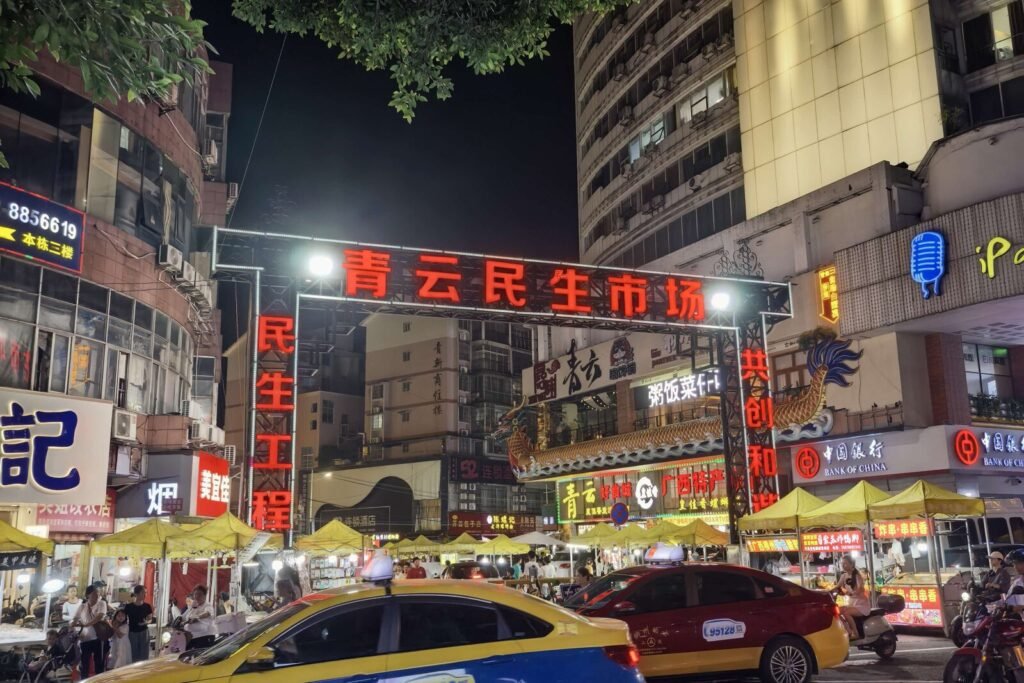
Practical Information for Visiting Liuzhou
Getting there and around: Liuzhou is well connected. By air, the city is served by Liuzhou Bailian Airport. By rail, Liuzhou Railway Station and Liuzhou East Railway Station are key regional high-speed rail hubs where the Xiang-Gui Railway and Guiyang-Guangzhou High-Speed Railway lines intersect — trips to Guilin or Nanning typically take somewhere around one to two-plus hours. Within the city, buses and ride-hailing apps cover most needs, and the main attractions are close enough together to comfortably explore over two to three days.
Best time to visit: With its subtropical monsoon climate, Liuzhou is most pleasant in spring and autumn (roughly March–May and September–November), when temperatures are mild and rainfall is lower. Summers are hot and humid, but also a great season for a nighttime river cruise and soaking up the city’s evening atmosphere.
Simple itinerary ideas: With one to two days, a solid route links the Liuhou Shrine, the Confucian Temple, Yaobu Old Town, and either Standing Fish Peak or Ma’an Hill, with a Liujiang night cruise and a proper bowl of fresh luosifen for dinner. With more time, add a day for Longtan Park or Duole Cave to take in the karst scenery, or extend further out to Sanjiang or Rongshui for a taste of the region’s ethnic minority culture.
Where to stay: Accommodation in Liuzhou tends to cluster around the railway station, the downtown commercial district, and the riverside area. Staying along the river is a good way to balance convenience with easy access to the nighttime views.
Frequently Asked Questions About Liuzhou
What province is Liuzhou in, and how far is it from Guilin and Nanning?
Liuzhou is in Guangxi Zhuang Autonomous Region, in the north-central part of the region. Along with Guilin and Nanning, it’s one of Guangxi’s major cities, and all three are typically within a couple of hours of each other by high-speed rail or highway — making a “Guilin–Liuzhou–Nanning” multi-city itinerary an easy option.
Is Liuzhou worth a dedicated trip?
If you’re looking for more than pure scenery — if you also want the everyday buzz of a real working city alongside a distinct industrial character — Liuzhou can be a genuine surprise. The river winding through town, authentic luosifen, and a one-of-a-kind automotive industry culture together make for an experience quite different from purely scenic destinations like Guilin or Yangshuo.
What should I know before trying luosifen in Liuzhou?
The dish’s signature smell comes mainly from fermented bamboo shoots. If you’re not sure how you’ll react, start with a milder, less spicy version with lighter toppings. Freshly cooked luosifen from a local shop tastes noticeably different from the packaged versions sold in supermarkets or online, so it’s worth prioritizing the fresh version while you’re actually in the city.
What souvenirs or specialties can I bring home from Liuzhou?
Packaged (bagged) luosifen is by far the most portable and iconic souvenir. Local ingredients like fermented bamboo shoots and dried tofu skin, as well as locally crafted ornamental stone pieces, are also popular items visitors take home.